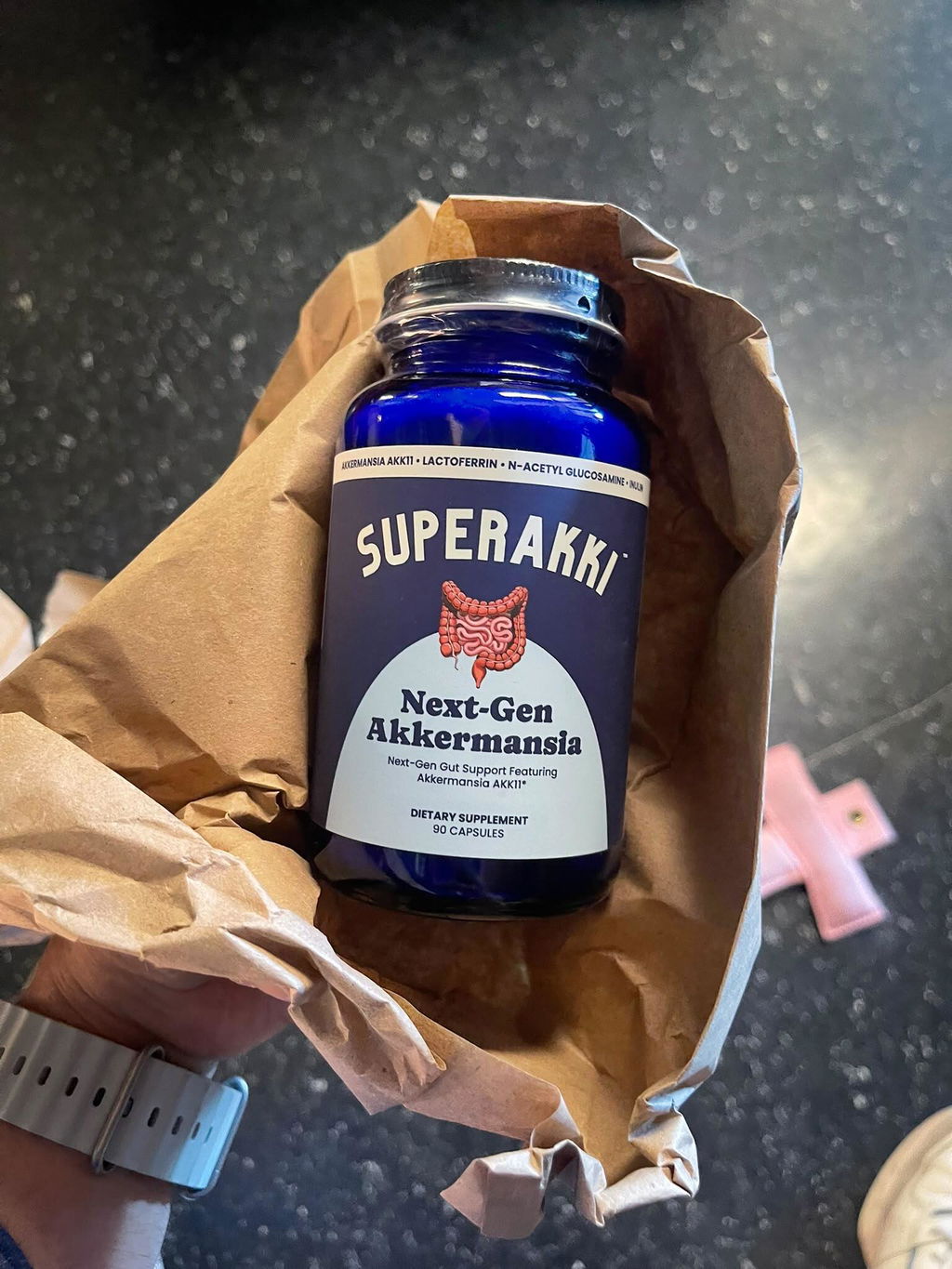
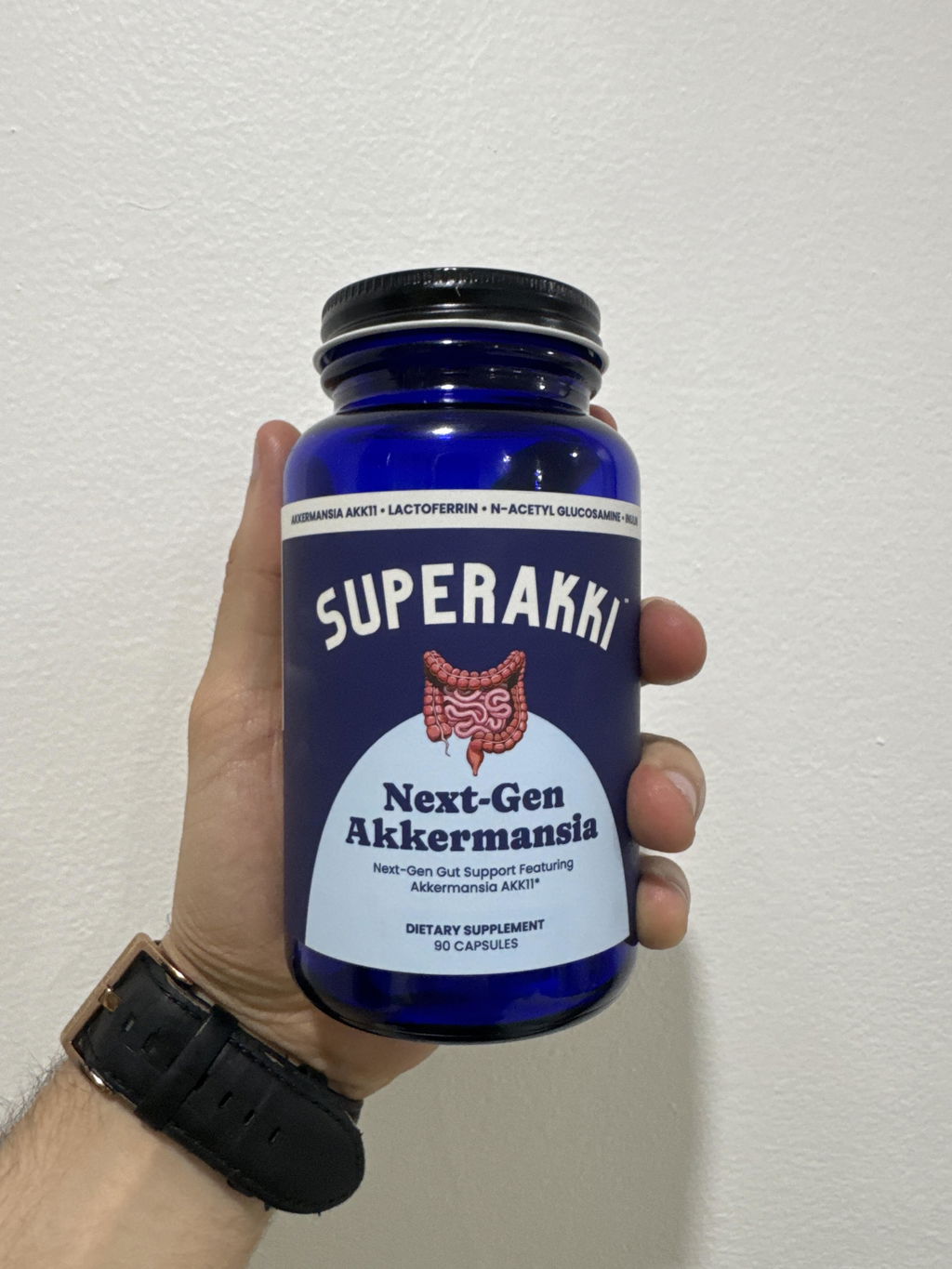
The Science Behind SuperAkki®
Research-based serving amounts
Every ingredient has a reason. Every amount has a reference.
We will show you every milligram, every study, every reason. Most of this industry goes light on amounts by default. We do not.

The formula at a glance
Four ingredients. Four reasons.
No proprietary blends. Here is exactly what is in every three-capsule serving, and the published research amount each one is matched to.
| Ingredient | Amount | What it does | Research context |
|---|---|---|---|
Akkermansia Akk11 (pasteurized) |
30 billion TFU | Supports gut lining and microbial balance* | Matched to the 3.0×10¹⁰ cells/day used in the Akk11 RCT 2026, same strain |
NAG (N-Acetyl-D-Glucosamine) |
1,000 mg | Supports the mucus layer and gut barrier* | Matches the Vinderola 2026 ex vivo study (1 g/day) |
Bioferrin® Lactoferrin |
250 mg | Supports digestive comfort and microbial balance* | Same tier as the Mhatre 2020 RCT (200 mg/day arm) |
Organic Agave Inulin |
250 mg | Supportive prebiotic component* | Below the typical studied amount. A supportive role, honestly disclosed |
Where it all happens
One thin layer. A lot riding on it.
Most of what people mean by "gut health" comes down to a single thin barrier between you and everything you eat. Picture three layers working together: the lumen, where food and microbes pass through; the mucus layer, a protective gel that coats the gut wall; and the epithelium, a single sheet of cells held together by tight junctions.
SuperAkki® is built around the ingredients that support this system, and each one works in a specific place.*

Ingredient deep dives
The four ingredients, in detail.
How they work together
Built to reinforce each other.
The four ingredients were not chosen at random. They map onto the same system, and they were designed to support each other. Mucus feeds the microbe. The microbe supports the mucus. The wider environment supports the microbes. It is a loop, and SuperAkki® was formulated to support each point on it.*

Research-based serving amounts
Every serving is formulated to follow the evidence.
Every serving of SuperAkki® is formulated to follow the evidence. Each ingredient is included at the amount used in published research. 30 billion TFU of pasteurized Akk11 matches the published amount in the Akk11 RCT 2026. 1,000 mg of NAG matches the Vinderola 2026 ex vivo work. 250 mg of Bioferrin® sits in the same tier as the Mhatre 2020 RCT active arm.
One honest exception. Organic agave inulin at 250 mg is below the typical bifidogenic research threshold. We include it as a supportive synergistic component, not as the primary microbiome modulator. We tell you this because you deserve to know it.
Inulin is shown separately as an honest "below the studied amount, disclosed" callout, not as a matched bar.
Key references
Underpinned by research published in Nature Medicine · Annals of Microbiology · Nutrients · International Journal of Environmental Research and Public Health
- Depommier C. et al. (2019). Supplementation with Akkermansia muciniphila in overweight and obese human volunteers. Nature Medicine, 25, 1096–1103.
- Akk11 RCT 2026. Synbiotic formulation containing Akkermansia muciniphila Akk11. Annals of Microbiology. DOI: 10.1186/s13213-025-01839-1
- Vinderola G. et al. (2026). N-Acetylglucosamine and immunoglobulin strengthen gut barrier integrity. Nutrients, 18(2), 210.
- Mhatre S. et al. (2020). Effects of lactoferrin on prevention of acute GI symptoms in winter. Int. J. Environ. Res. Public Health, 17(24), 9582.
- Plovier H. et al. (2017). A purified membrane protein from Akkermansia muciniphila. Nature Medicine, 23, 107–113.
- Salminen S. et al. (2021). ISAPP consensus statement on postbiotics. Nat. Rev. Gastroenterol. Hepatol., 18, 649–667.